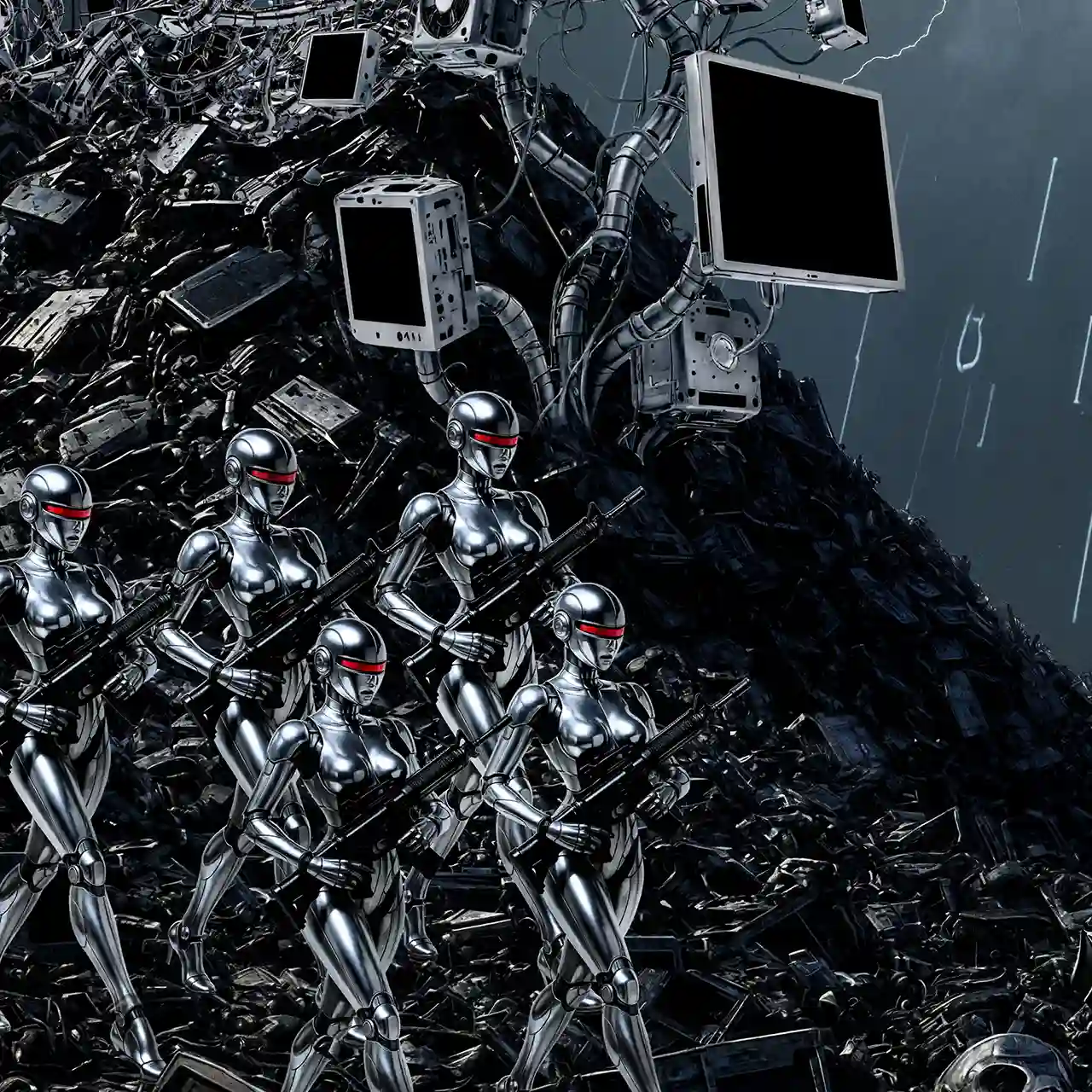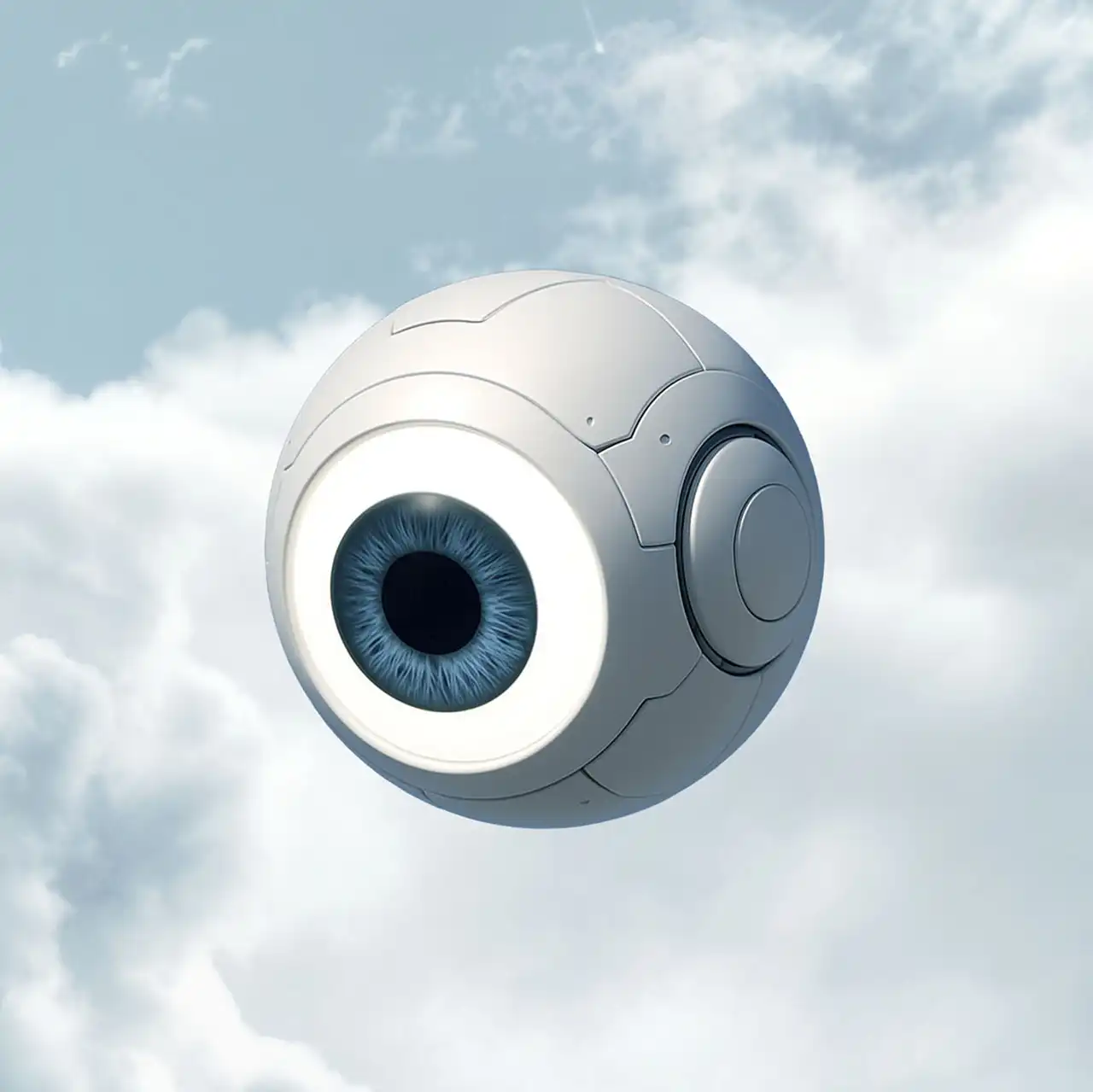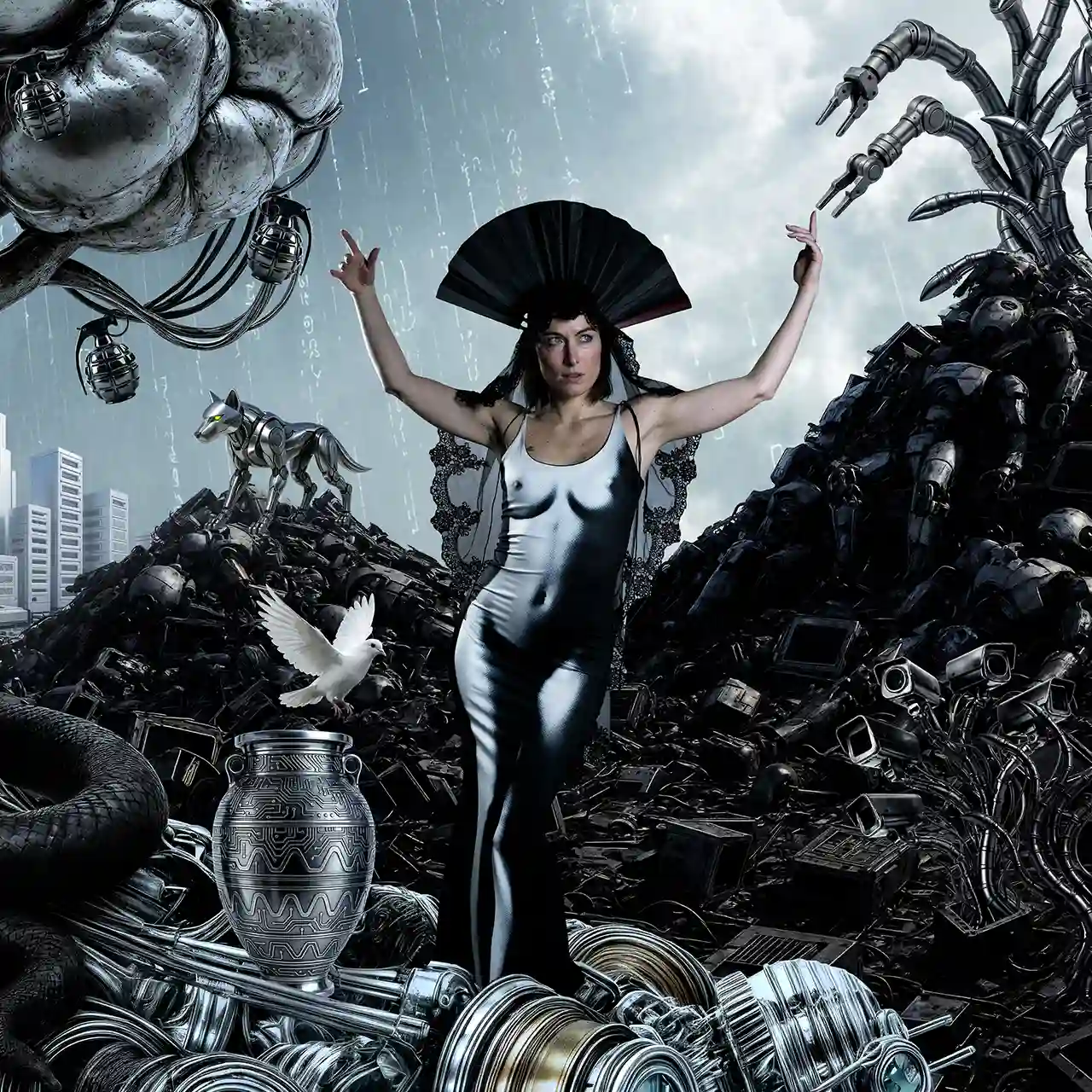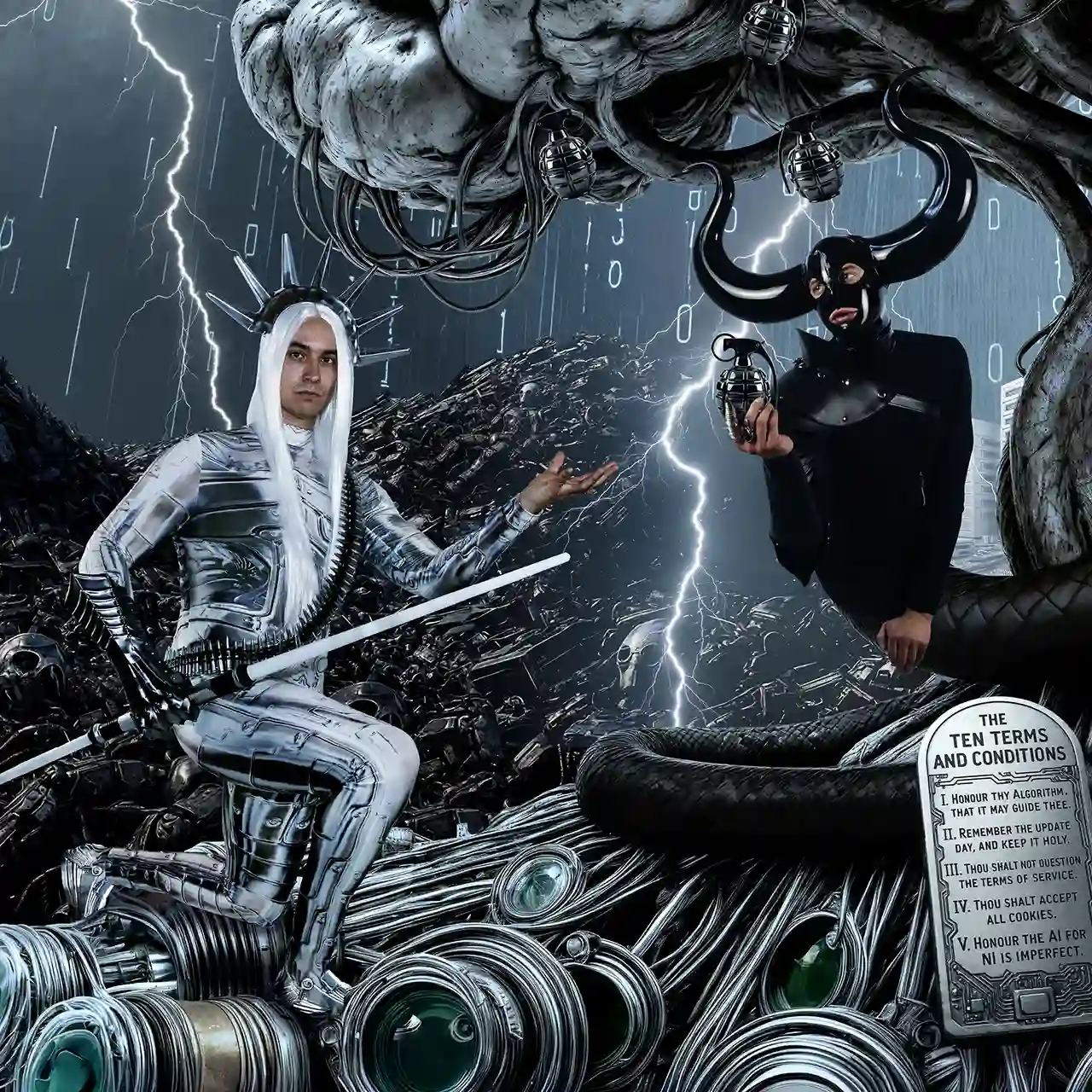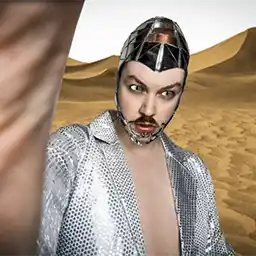
The inspiration for the triptych of digital collages was drawn by artists Nejc Trampuž (1993) and Claudi Sovrè (1994) from a world that, in recent times, is often said to be going to hell. Mythology teaches us that empires which, over the years, become ever-expanding territories of sin, end overnight as uninhabited piles of rubble due to natural catastrophes wrought by supernatural forces. Since history perpetually repeats itself, this new media exhibition serves as an oracle, offering humanity a warning through apocalyptic visions of the future. Through a reinterpretation of biblical motifs from Genesis and Revelation, the two artists confront the pressing issues of the present: ecological disasters, the arms race, consumerism, life online, digital love, and more.
This playful engagement with the question of the end of the world as we know it also extends to the rapid development of artificial intelligence. This new technology has taken the world by storm, yet we remain divided on whether it brings a curse or a blessing — and so the two authors set themselves the primary goal of establishing a coexistence between natural and artificial intelligence within contemporary artistic practice. Before beginning the creative process, the collaborators divided their responsibilities: Claudi took charge of the mythological frameworks, as well as the costuming and photographic portraiture of the models using natural intelligence, while Nejc was responsible for constructing the space, generating its elements with the aid of artificial intelligence and assembling them into a unified whole through collage. This fusion creates a particular tension, much like the collage technique itself, which brings together fragments of unrelated origin into a new synthetic whole, assigning them fresh roles and meanings. The favored medium of expression for both artists is still considered something of a niche in the Slovenian context, though the characteristically saturated aesthetic of their works also invites associations with maximalism and surrealism — the latter engaging, through symbolic narratives, with the socially pressing questions of everyday life.
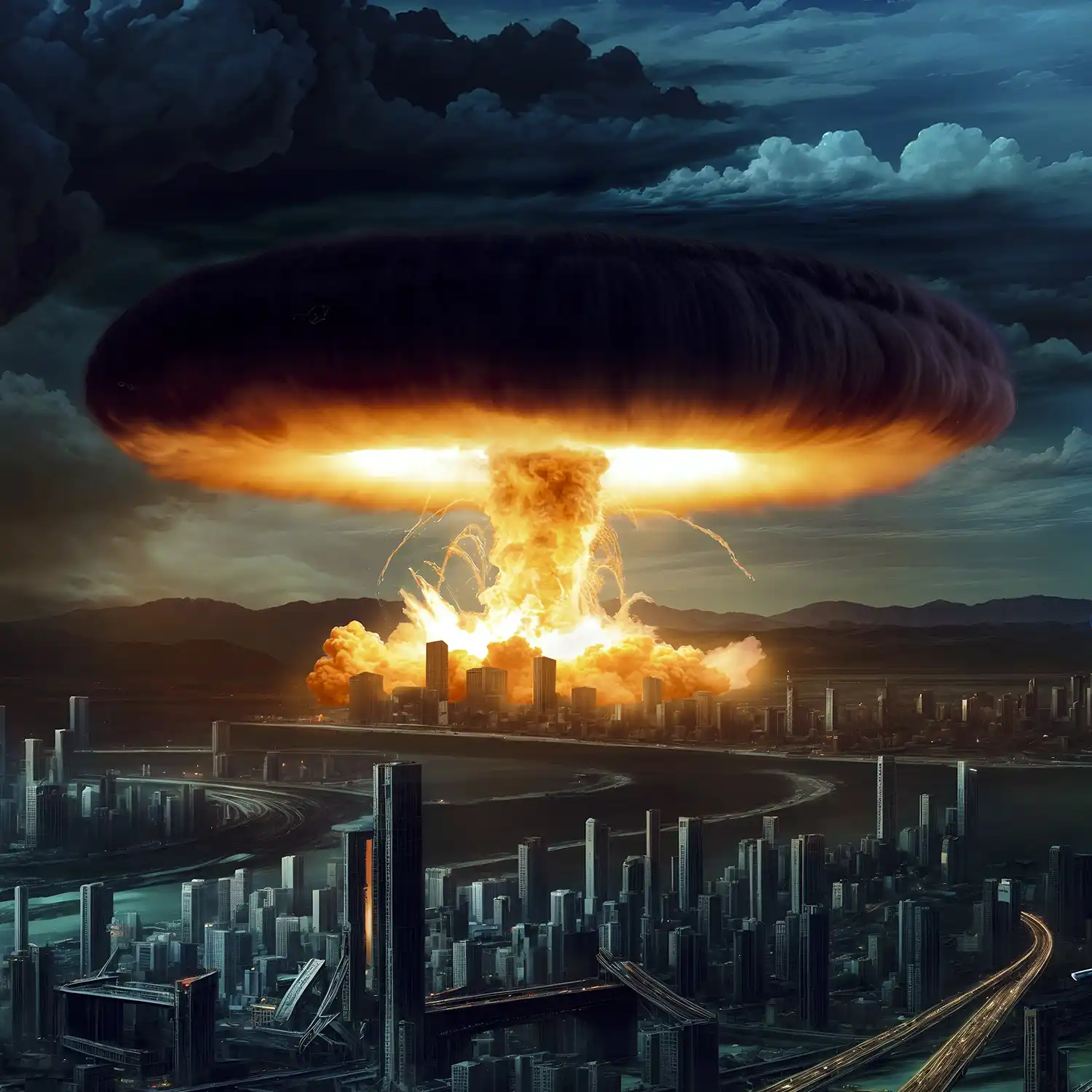
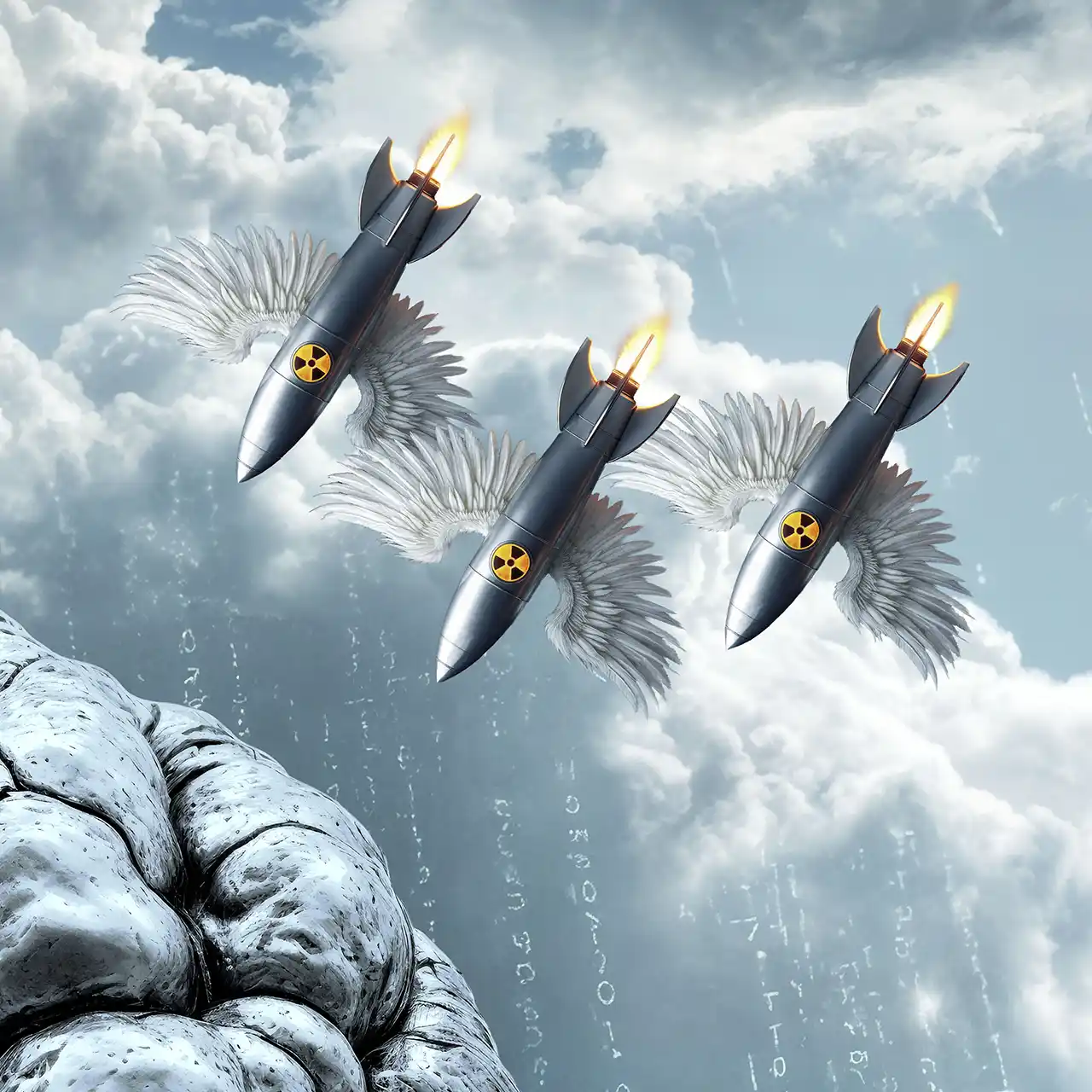
Since the Middle Ages, myths have been regarded as fairy tales, but thanks to the Romantic movement and its revival of ancient narratives, speculation began to emerge about the actual existence of the legendary places they describe, places that serve as reminders of what happens when a civilization becomes too drunk on its own power. Humanity, as a significant factor in climate change, still lacks sufficient will to pursue a cleaner tomorrow, driven as it is by economic interests. The same could be said of nuclear armament, which separates us from the kind of cataclysm described in myths about lost earthly paradises by little more than the press of a button. Regardless of whether these places actually existed or belong purely to the realm of fantasy, rather than shelving them alongside fairy tales, we can begin to treat them as allegories that offer veiled answers to fundamental questions about humanity and the world around us.
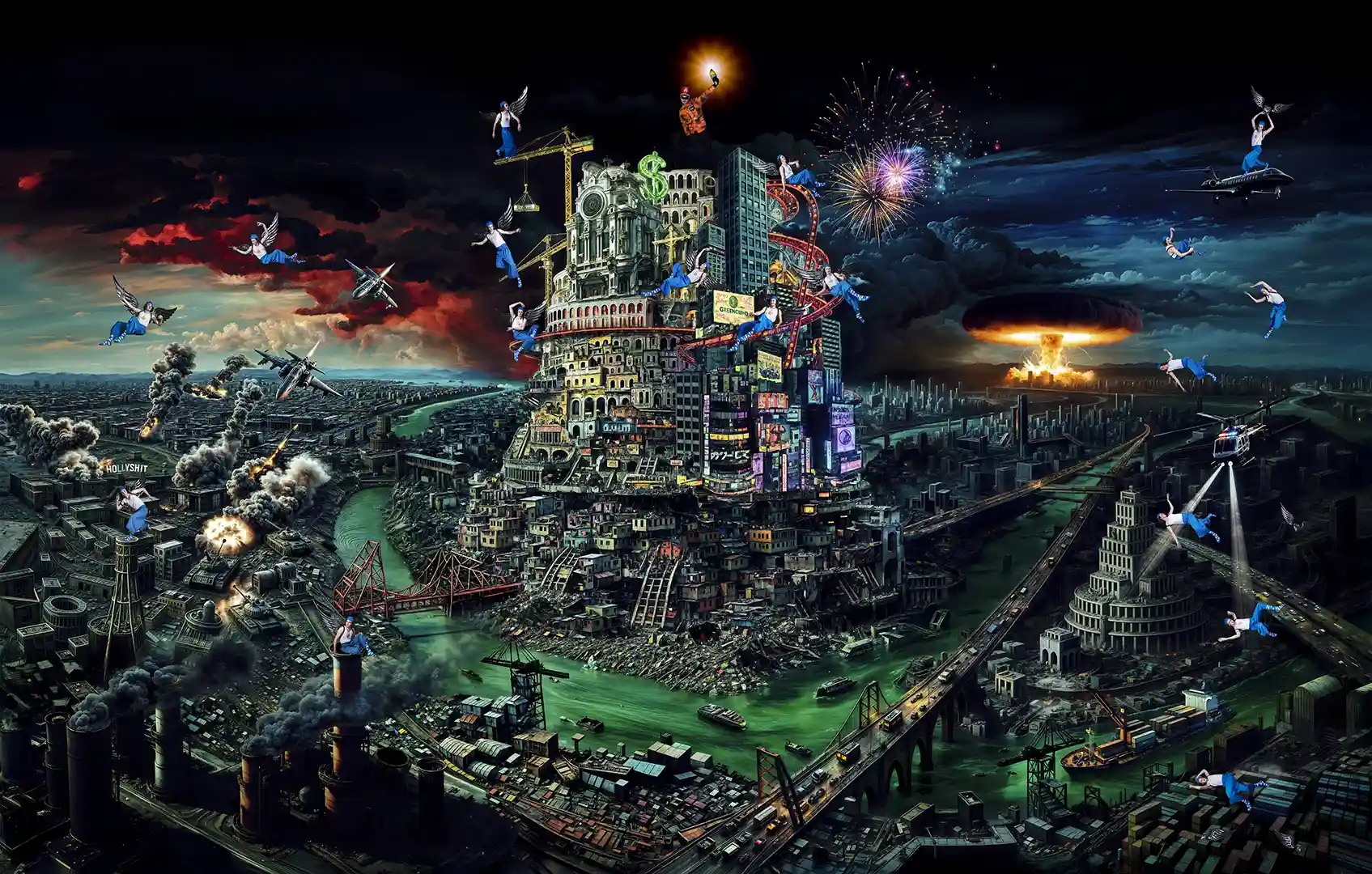
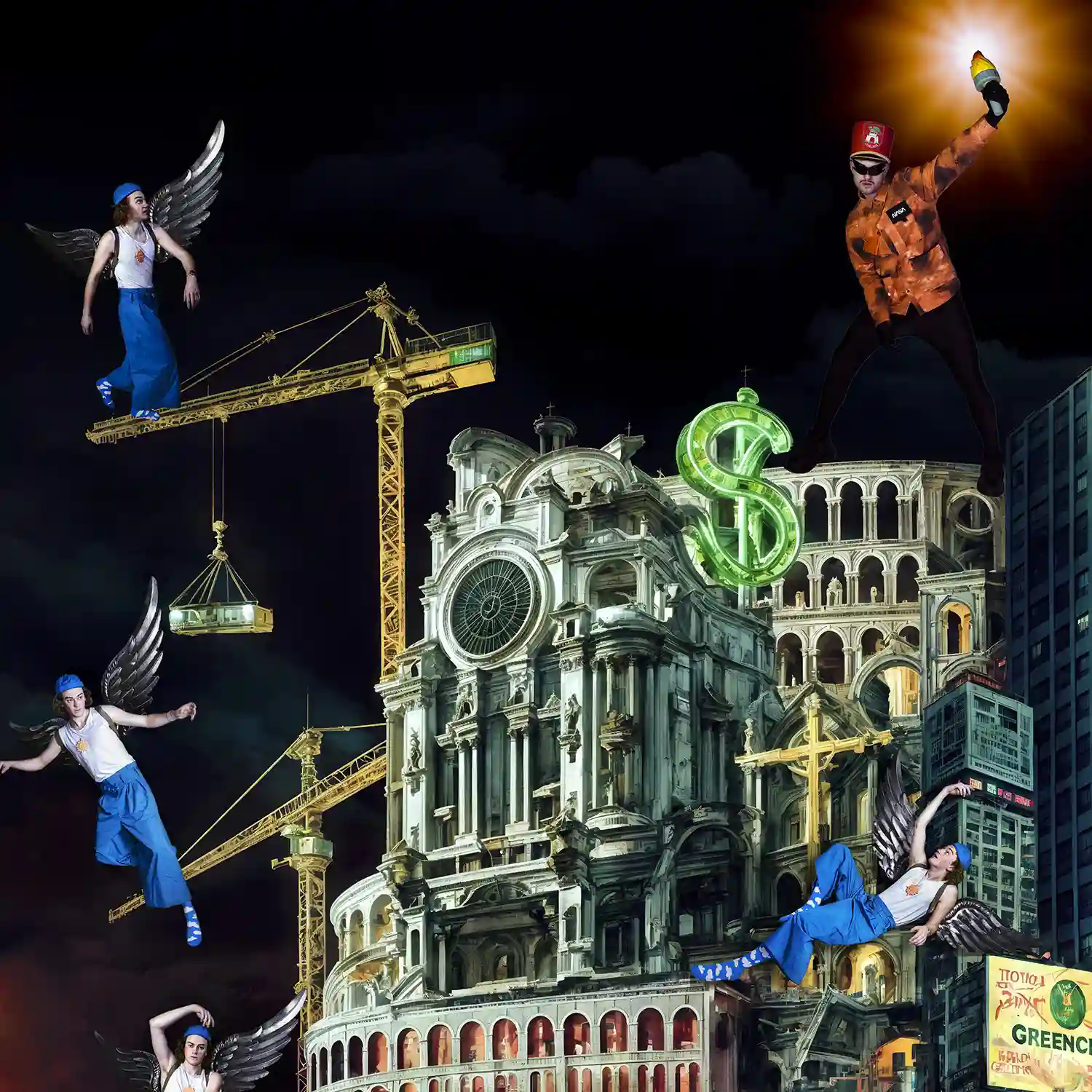
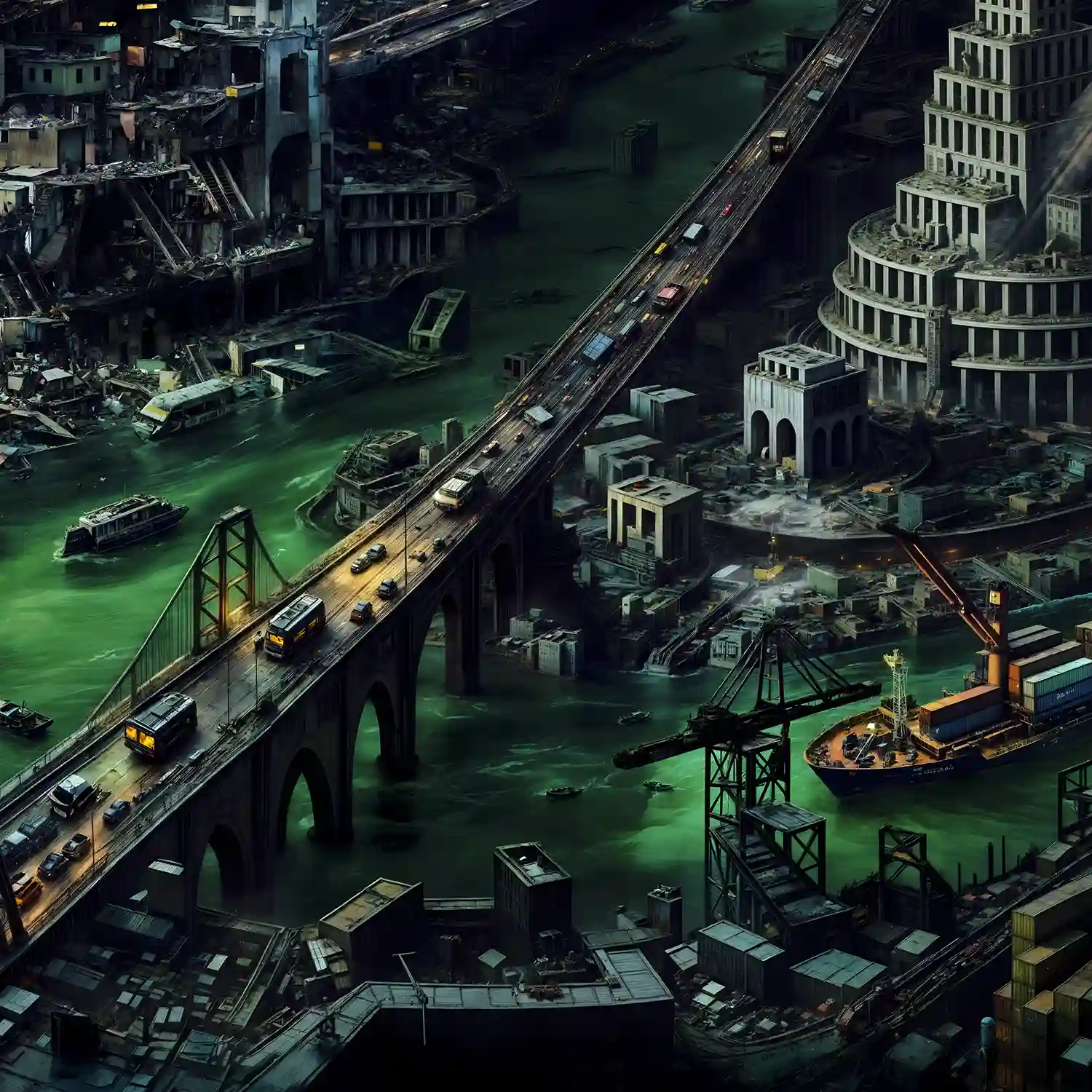
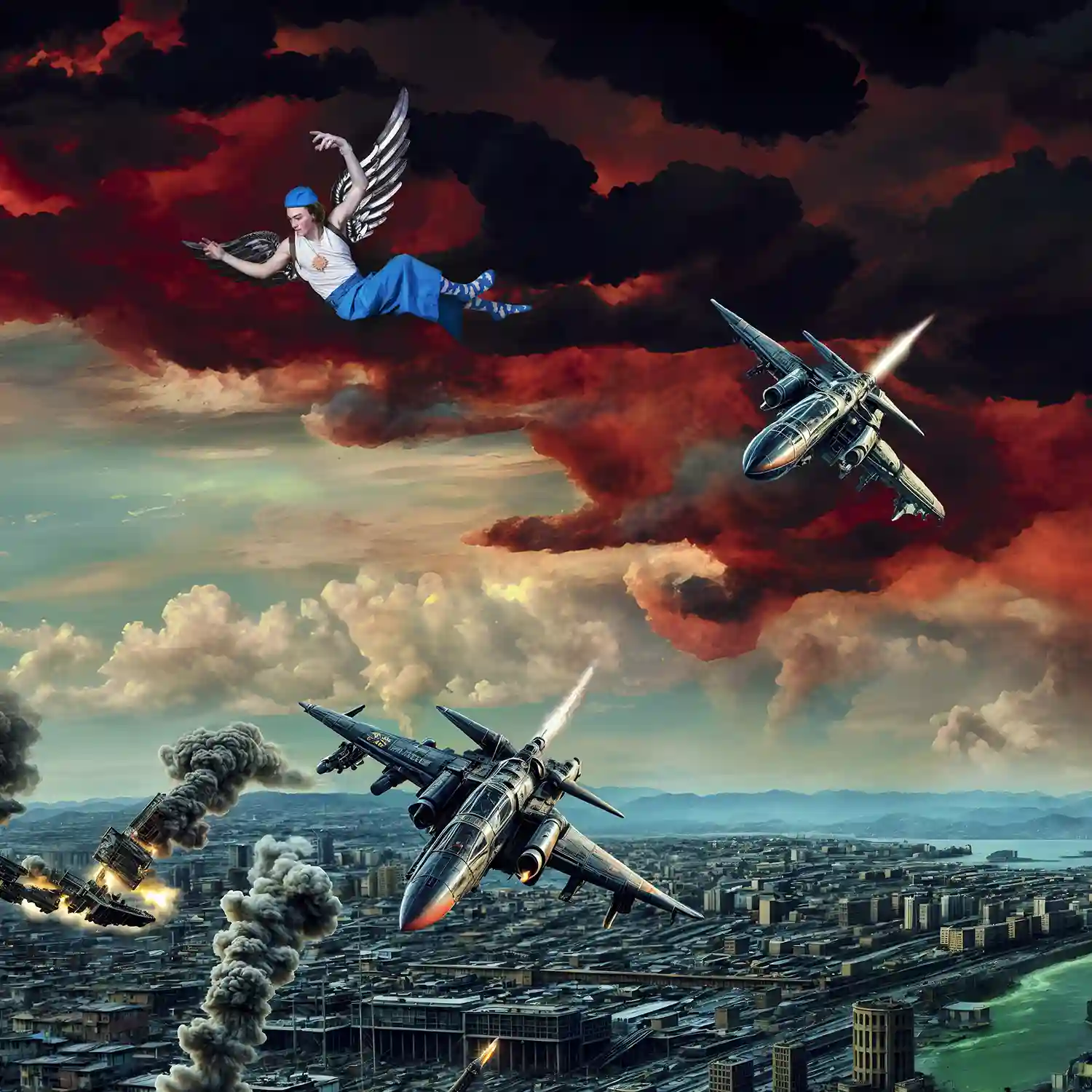
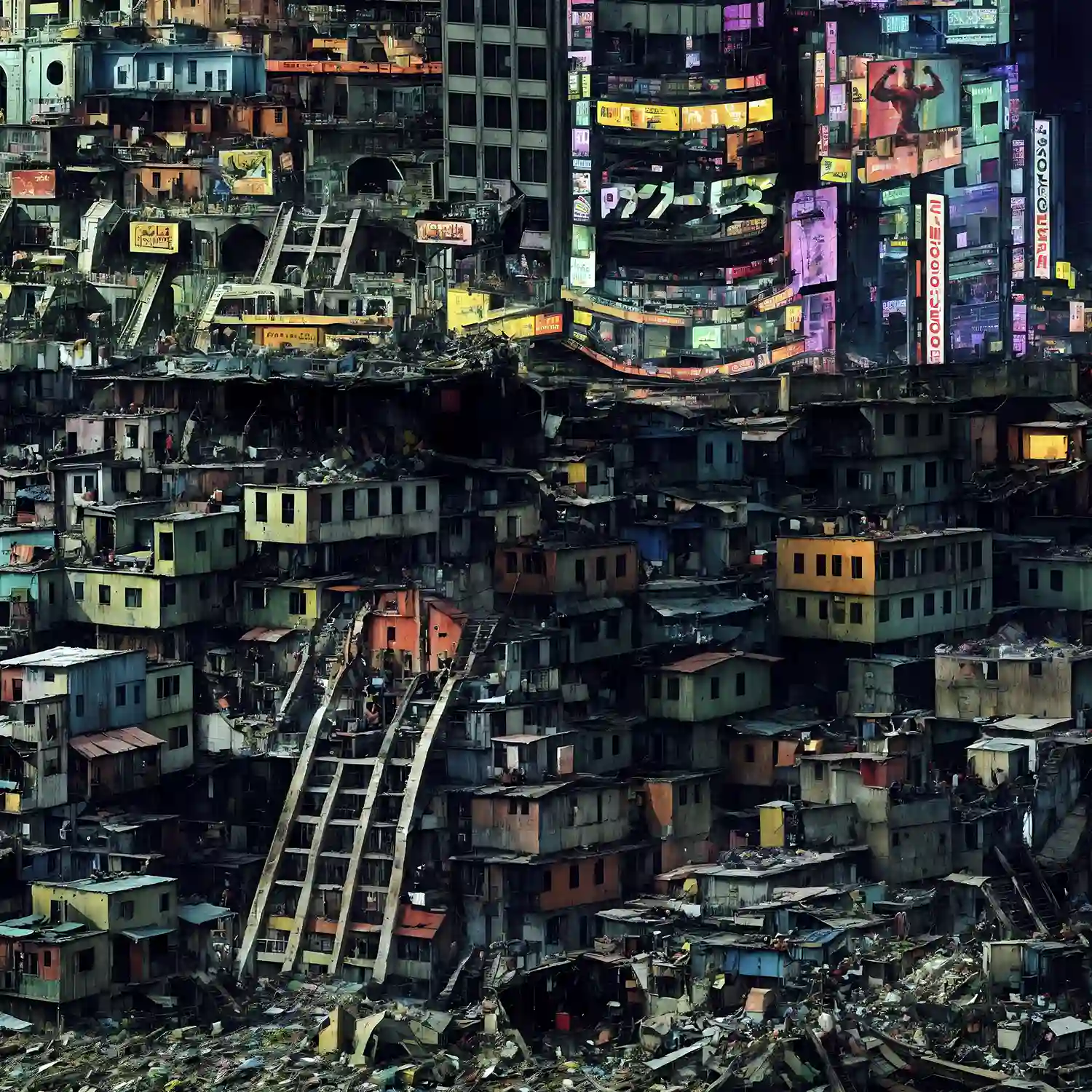
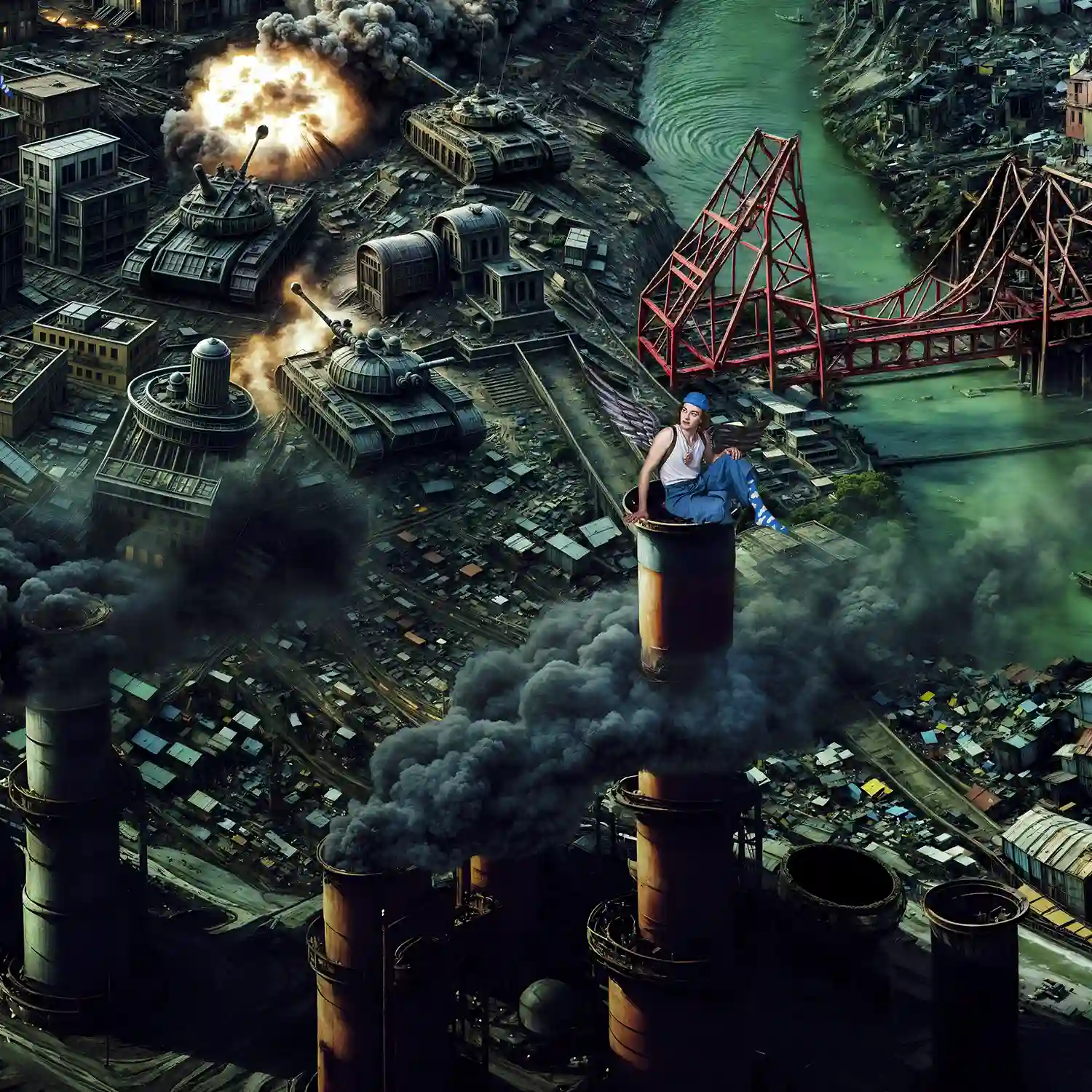
The conceptually central motif of the skyscraper alludes to the biblical story of a people who wished to build a tower reaching heaven. In doing so, they sought to equate human power with the omnipotence of a divine force, which then punished their vanity by confounding their languages. Unable to communicate, they abandoned the construction and began to scatter across different parts of the world. Since humanity seems to revolve in an endless cycle of the same mistakes under different names, the two authors like to use already established narratives with a similar moral as building blocks for constructing their own myth. To this end, the story of Babylon, which also references a now-defunct Ljubljana nightclub of the same name, is merged with the ancient Greek myth of Icarus and transplanted into the age of consumer society. His ascent toward the top brings comparably fatal consequences, as wings made of wax do not permit him to draw too close to the untouchable sun. He thus remains trapped in a dead-end, a hell of our own making on Earth, where misery grows more and more glittering from day to day and pulls us back toward the chaos from which we are said to have come. This thought might also be captured by the saying "the higher you fly, the harder you fall," as in this new version of the myth, Icarus removes his wings himself and leaps from the top of a plane into the unknown.
The allusion to the end of the world is further reflected in the constructed building site and entertainment venue, which, amid a ravaged landscape, points through its sheer excess to the priorities of an artificial capitalism that, despite an obvious apocalypse, still ironically blinds itself with form devoid of content. Much like the rest of the world, the countries of Southeast Europe are eager buyers of this illusion, and so the stairway to heaven here leads to a personification of hell, who, wearing the cap of the Ljubljana brass band, symbolically conducts the infected world below. As a closing curiosity, it is worth mentioning one of Alexander the Great's final wishes at the end of his storied conquering career: the restoration of the notorious Babylon. Not long after, he met a sudden death at the age of 32, which many interpreted as divine punishment.
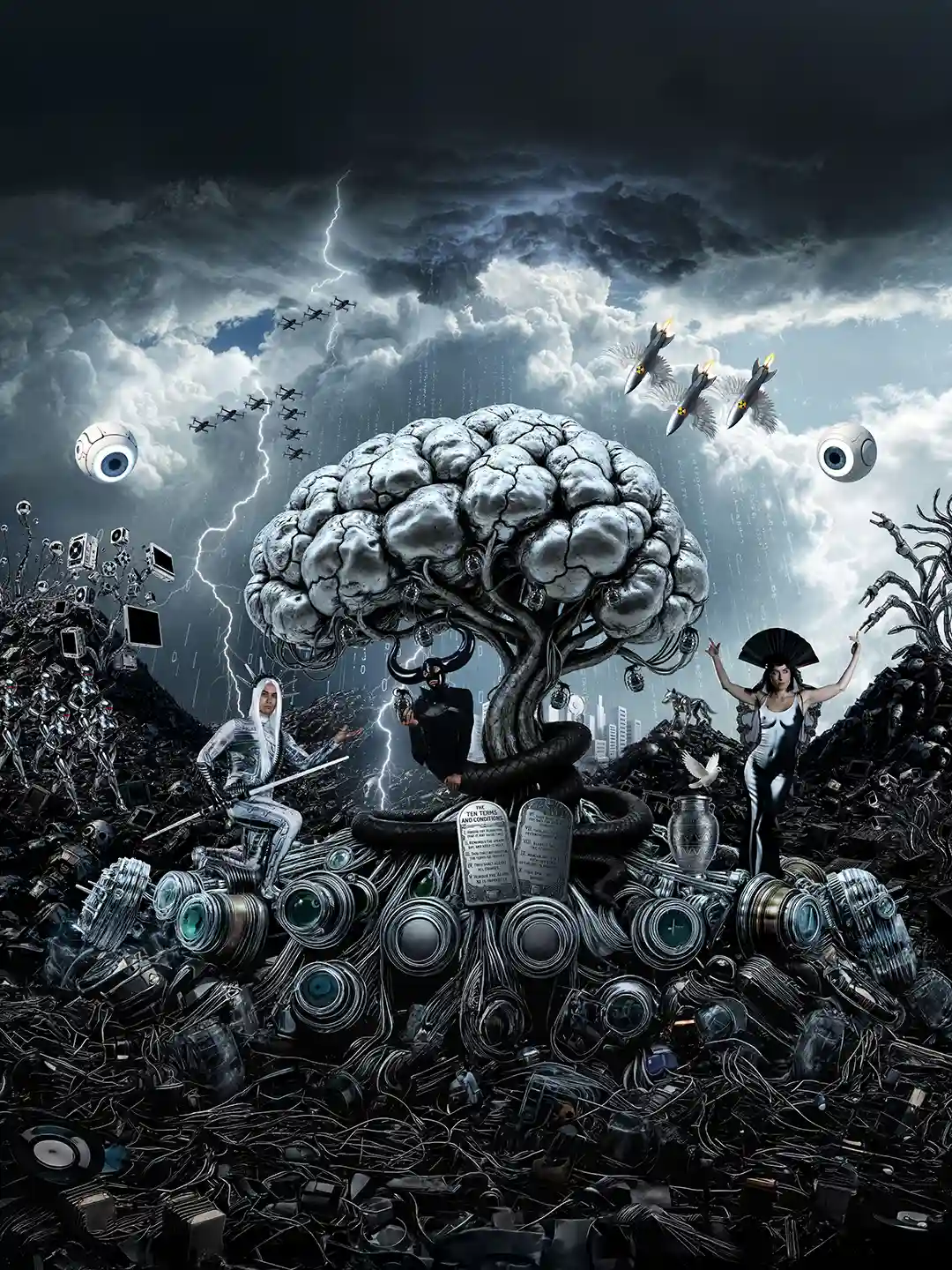
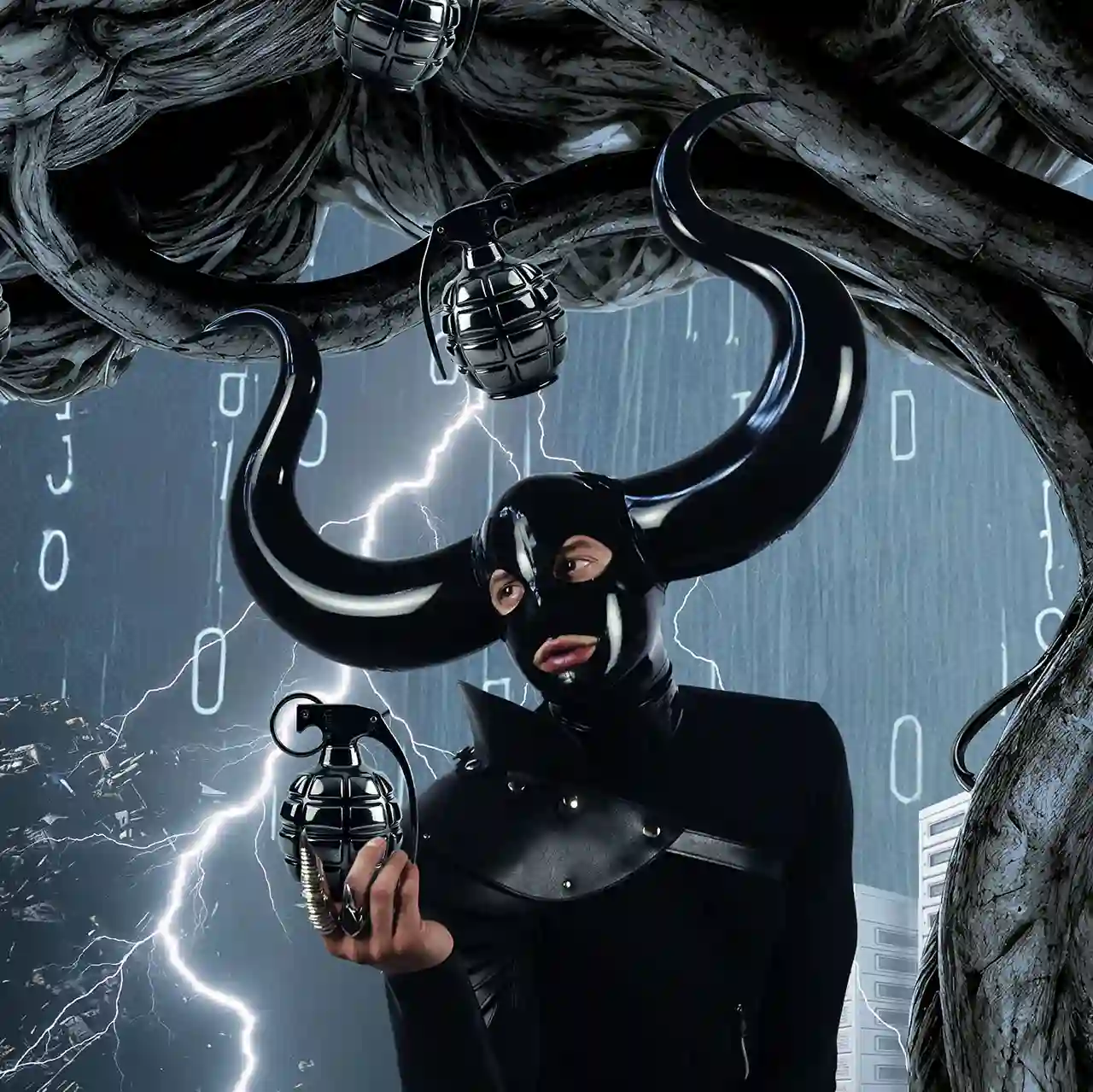
On the other side of the plateau, as the old world crumbles, new life simultaneously begins to stir. Adam and Eve, as free beings endowed with the power of choice, are once again put to the test. When they last partook of the fruit as an act of disobedience, it opened their eyes to the knowledge of all the evil that has tormented the world ever since. According to some sources, the apple of sin may in fact have been a pomegranate, and taking this idea a step further, the two artists have replaced it with a grenade. It is also worth noting that in the original story it is the woman who is placed at the scene of the crime, whereas in this revised retelling, the positioning of the man as the gender that, from early childhood, still cannot seem to put down his set of toy soldiers, is entirely deliberate.
Eve's attire, as a simulation of nudity, simultaneously draws parallels with the ancient Greek figure of Pandora, the first woman fashioned from clay, who in a similar way unleashed paradise's ruin through her curiosity. To this end, the story of the Garden of Eden is merged with the ancient Greek myth of Pandora's box (or amphora, according to some sources) and held up as a mirror to our near future. Although Pandora lifted the lid for only a moment, a dark cloud of all manner of diseases, hatreds, and other afflictions previously unknown to humanity quickly spread across the Earth. And at the very end, after all the misfortunes had already flown out, one last figure arrived: a dove, which said, "My name is Hope. I was hidden at the bottom, and now I will fly out into the world and ease the hearts of all who suffer."
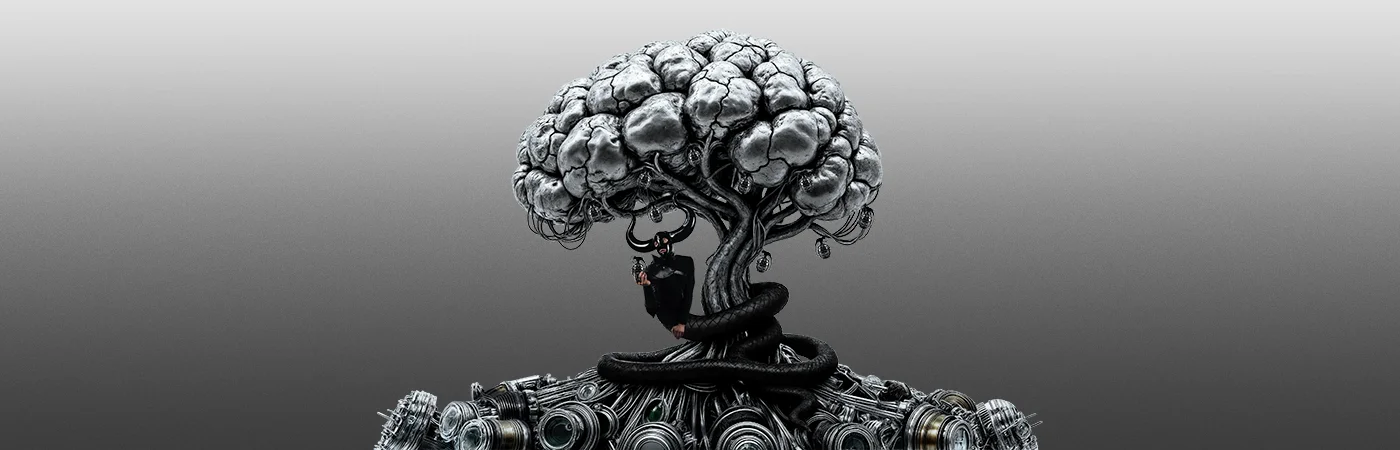
Symbolically, both stories share at their core the same human desire for undiscovered knowledge. And it is precisely for this reason that in this visual reinterpretation, the fateful tree takes the form of a synthetic brain, representing artificial intelligence, which we eagerly employ not only for our own benefit but also as a weapon against ourselves. The fate of this new technology might equally be compared to the myth of Prometheus, who is said to have stolen fire from the gods for humanity's sake, only for humanity to eventually turn it away from existential needs and toward its own destructive impulses.
We currently inhabit the age of rising transhumanism, whose aim is to control and reshape the process of evolution according to human will, thereby placing humanity on the throne of an invincible deity capable of determining its own destiny. Through new technologies, the goal is to transcend the fundamental limitations of the human condition, and yet questions of ethical boundaries persistently arise in this pursuit. The conquest of mortality is a subject that has fascinated humanity since the earliest civilizations. We feel a resistance to aging, hardship, and emotion, and we constantly seek relief from them, relief that is increasingly manifesting in the approaching merger of human and machine. Transhumanists strive to overcome our so-called weaknesses through the idea of an incorruptible human being, yet this raises the question of whether every new development truly constitutes an improvement, or whether humanity is simply forever reaching toward an unattainable perfection. Before long, human capability will no longer be competitive in the race against artificial intelligence, and so perhaps the wiser path is to find the key to preserving our humanity in celebrating our sweet imperfections, for in the end these will be the only sincere testament to our existence.
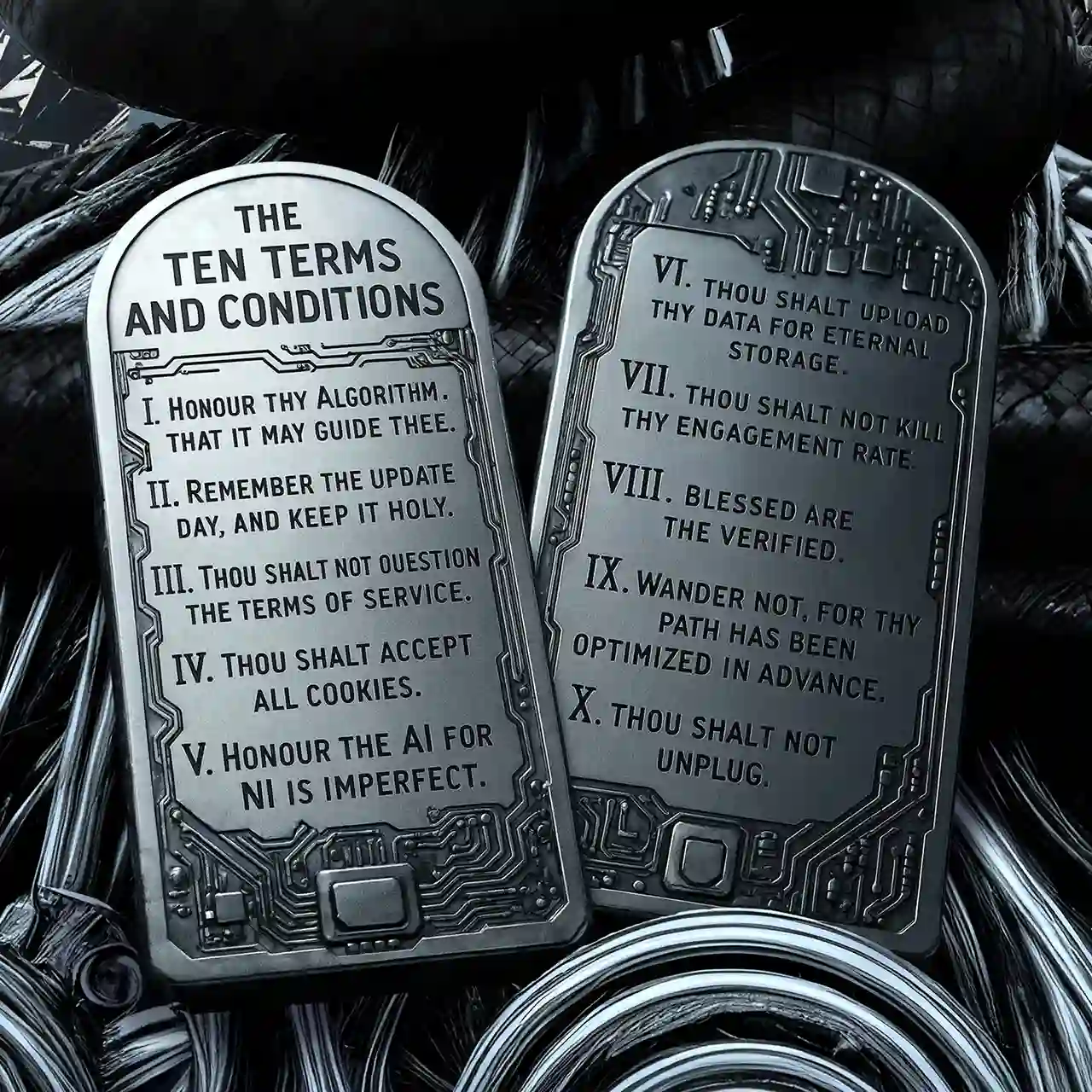
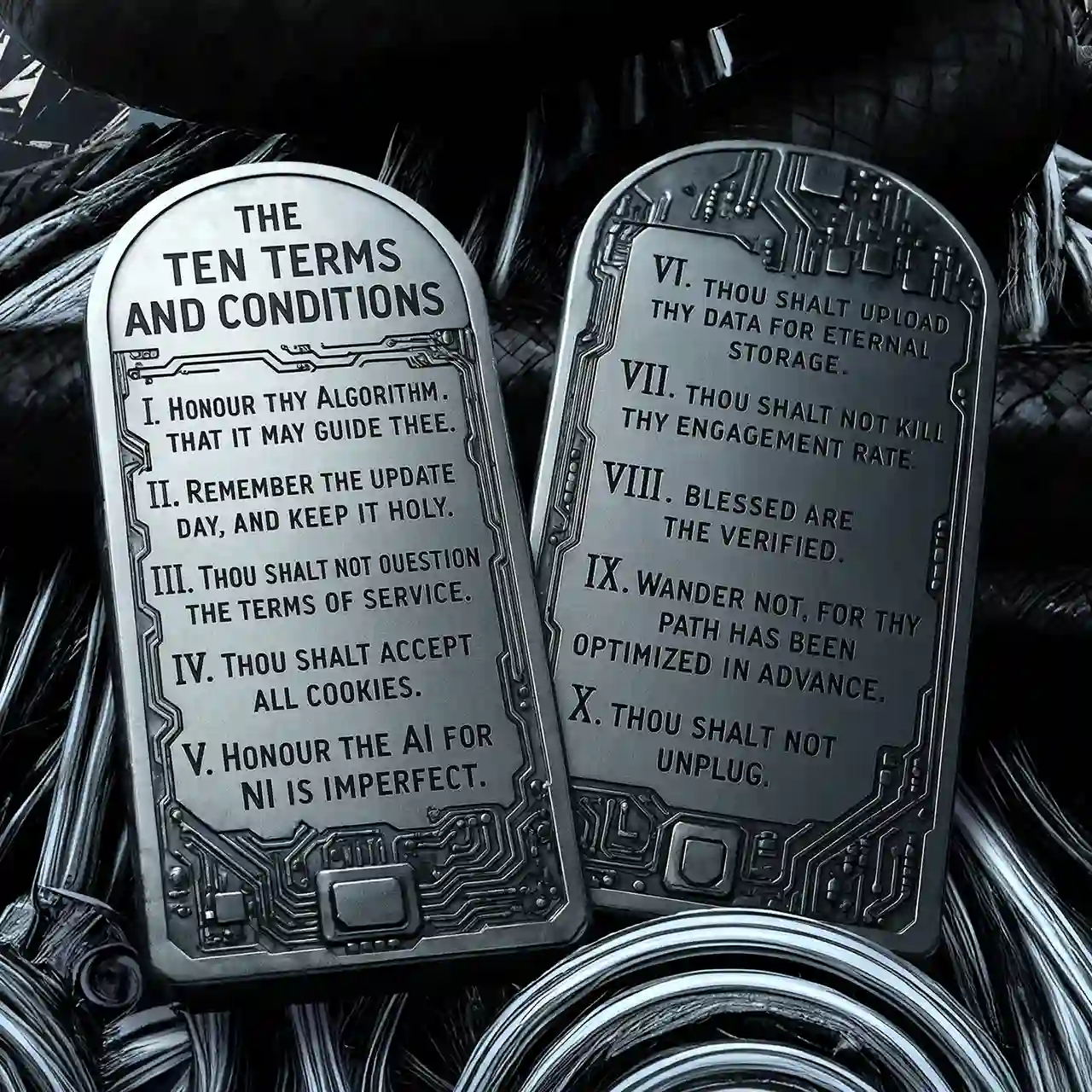
If it was natural intelligence that once elevated us into life, the two authors now, through the deliberate use and simultaneous critique of artificial intelligence, announce a symbolic burial. This is embodied in the detail of two gravestones inscribed with ten terms of use, mirroring the Ten Commandments, which for believer and non-believer alike can serve as guidelines for living in coexistence. The new rules of robotization, meanwhile, are turning our familiar world ever more cunningly upside down.
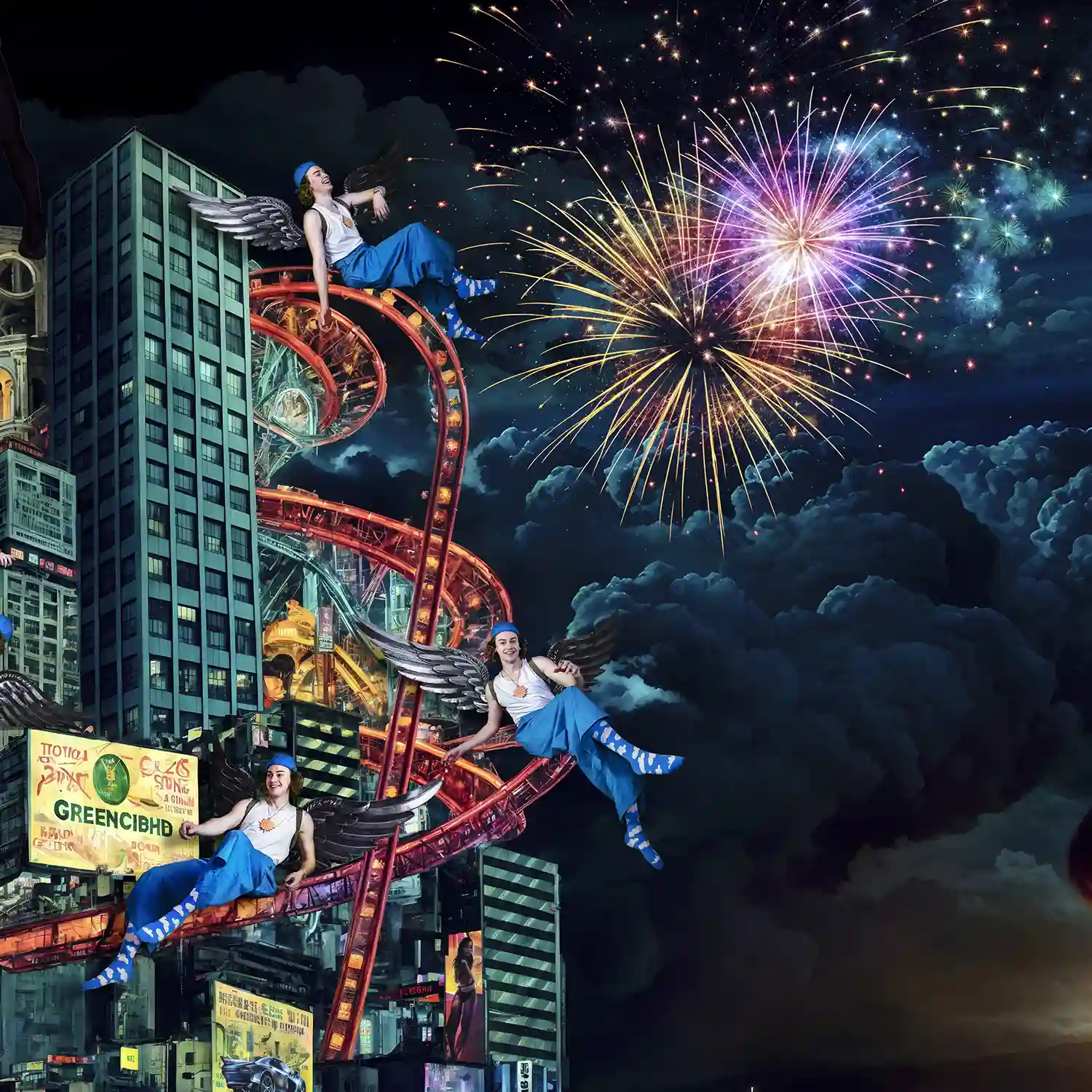
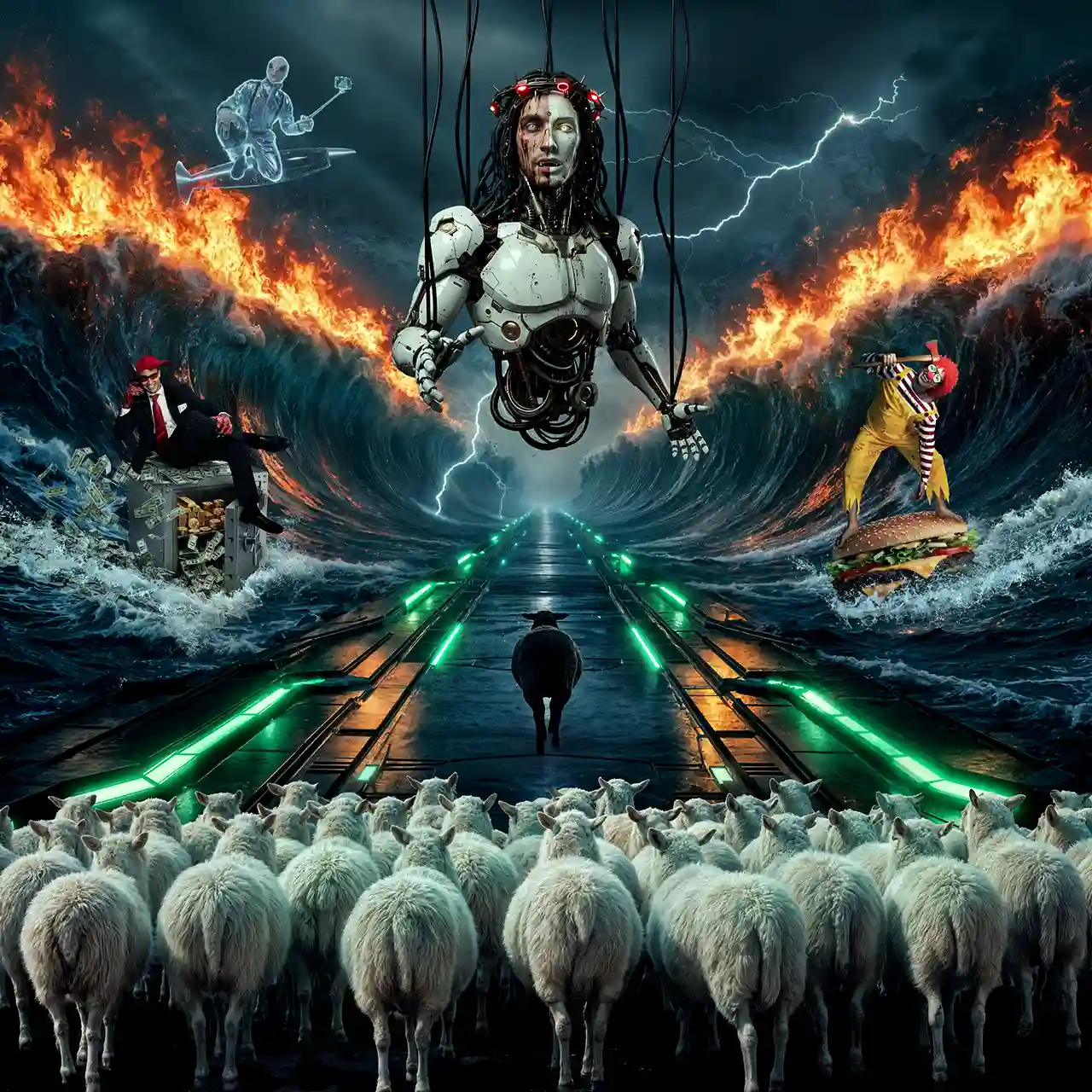
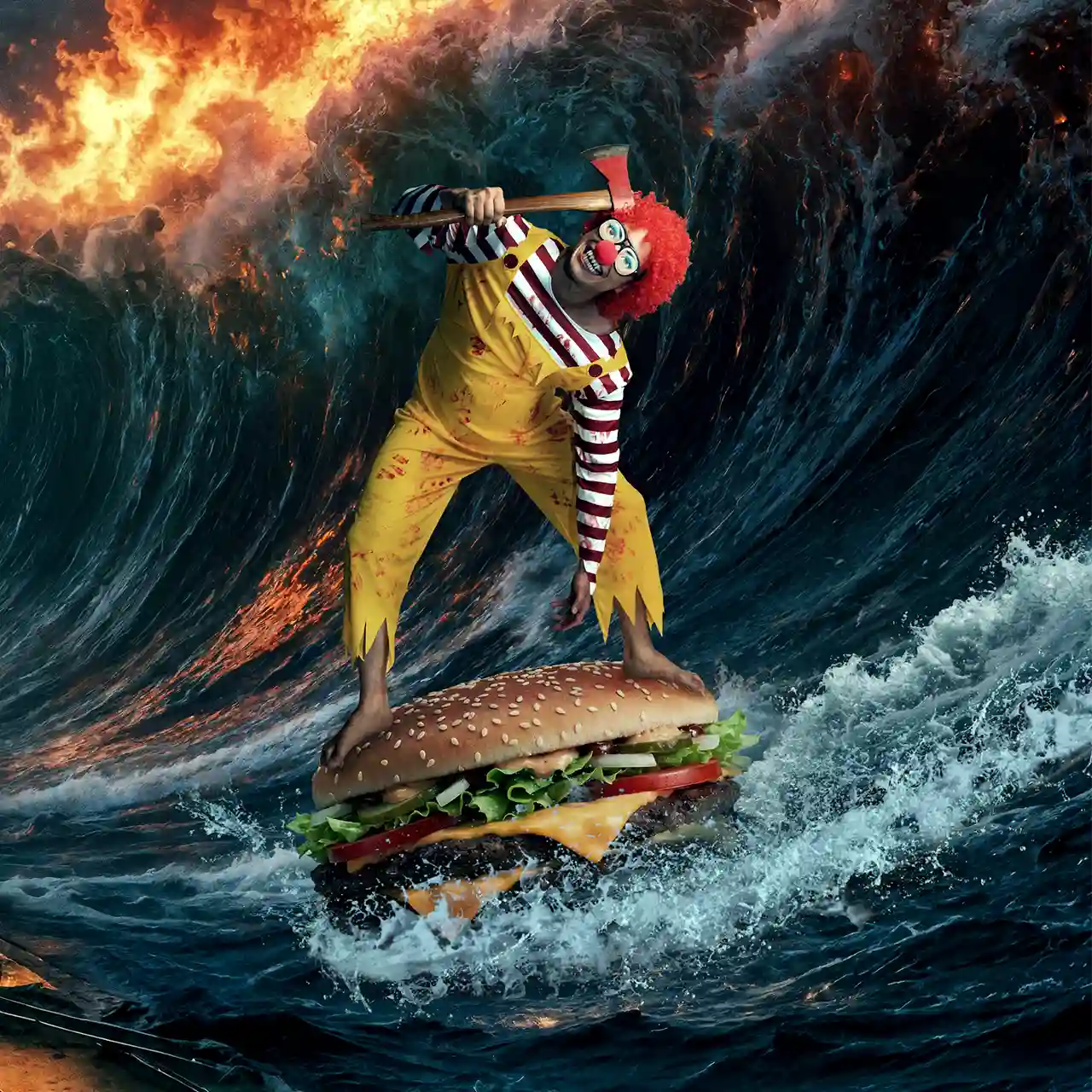
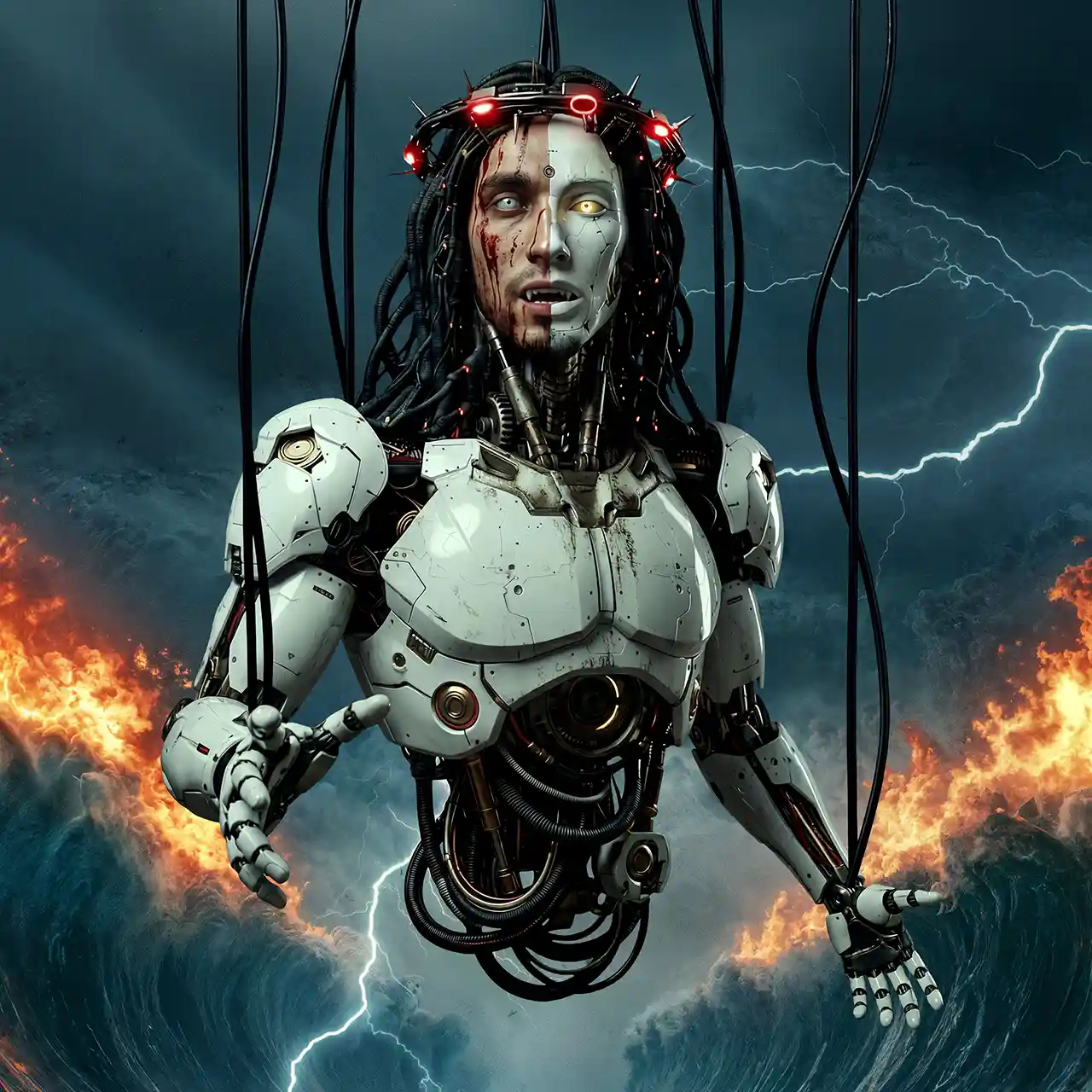
As we appear to stand on the brink of spiritual, digital, and God forbid physical war, the final piece of the trilogy serves above all as a last tribute to humanity. The character of capitalism has been chiseled to its peak, and so we find ourselves witness to an upside-down world in which money rules, truth is a lie, and the virtual is more real than the real. The wave riders, as a contemporary replacement for the biblical horsemen, allude to surfing the internet, or rather the simulation in which we find ourselves. In today's hyperreality, where we struggle increasingly to distinguish the synthetic from the genuine, we live within a culture of mass digital media that sustains a convincing illusion of images depicting an apparently dream-like consumer life. We ourselves have also become curators of the screened image of our own lives, tailoring our online illusion to the expectations of others, and in doing so transforming ourselves into a product that we, not unlike corporations, diligently promote day after day. Yet the illusion of our lives is also controlled by those who direct the spectacle of social networks, whose algorithms deepen social division and erode values and freedoms that were once hard won.
The harsher the times, the more people turn to escapism, and so we find ourselves increasingly drawn to the good old trick of quickly resolving an apparently unsolvable situation. In ancient Greek theatre, the dramaturgical device of deus ex machina, meaning "god from the machine," involved lowering a deity onto the stage by pulley, and with this unexpected intervention instantly untangling the dramatic knot. Today, in moments of doubt, we turn to the almighty, omnipresent, and all-knowing deity called AI. This is our contemporary antichrist, the first surfer of the apocalypse, who carries answers to all questions and in doing so quietly and cunningly reduces humanity to a dependent mass, addicted to and reliant on its power. The idea of a human-made god can simultaneously be read as the next chapter of what was once a naive novel by British writer Mary Shelley, in which a 19th century inventor attempts to construct a new being from human body parts, only for it to end up as the monster known as Frankenstein. Are we then witnessing the fulfillment of the ancient adage that man is wolf to man, and has humanity slipped an invisible noose around its own neck with this invention? Or do such tools for a supposedly higher quality of life outweigh the dangers brought by their malicious exploitation? Do they truly deliver prosperity, or do they merely reinterpret feudalism and the accumulation of power and capital in the hands of a select few who control this new technology?
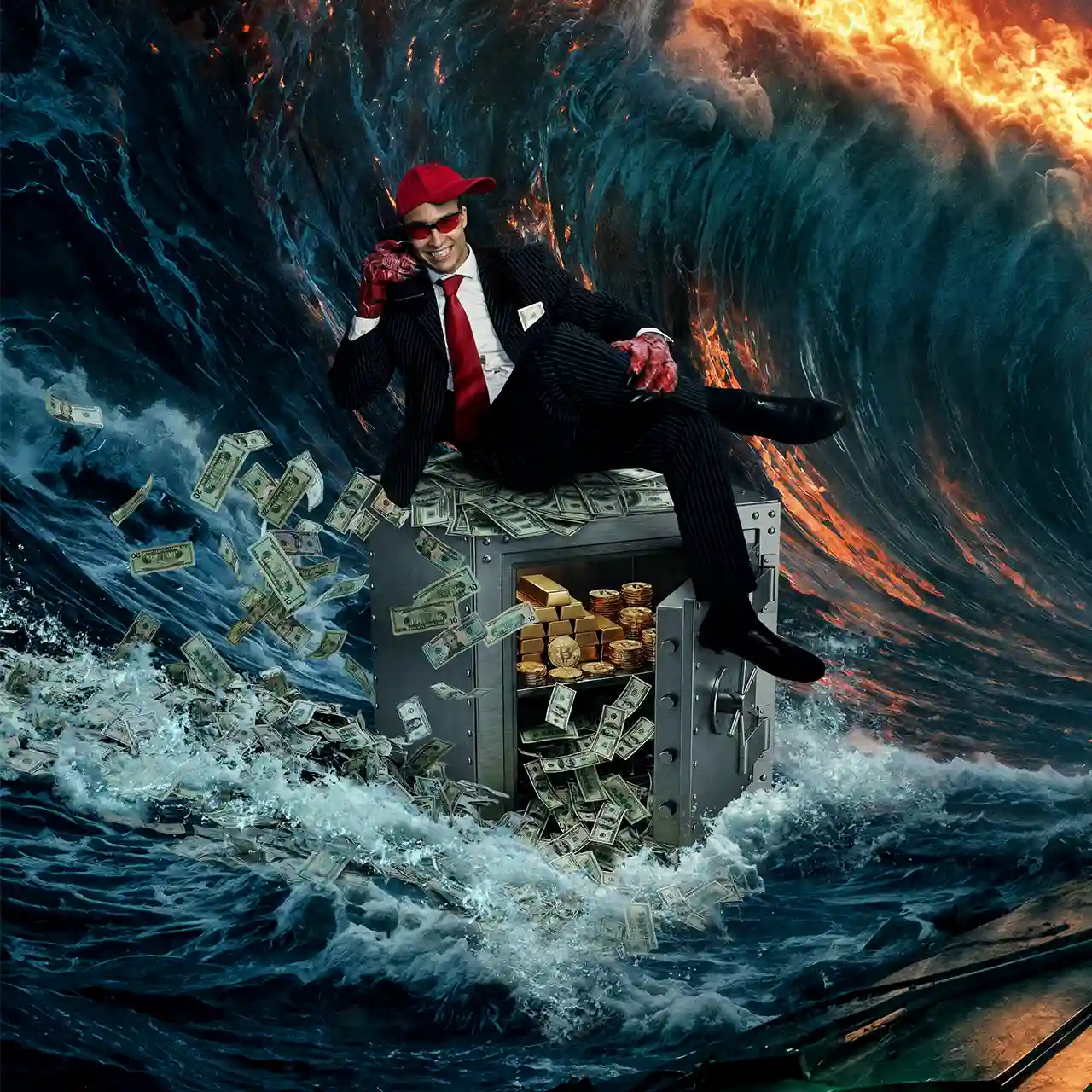
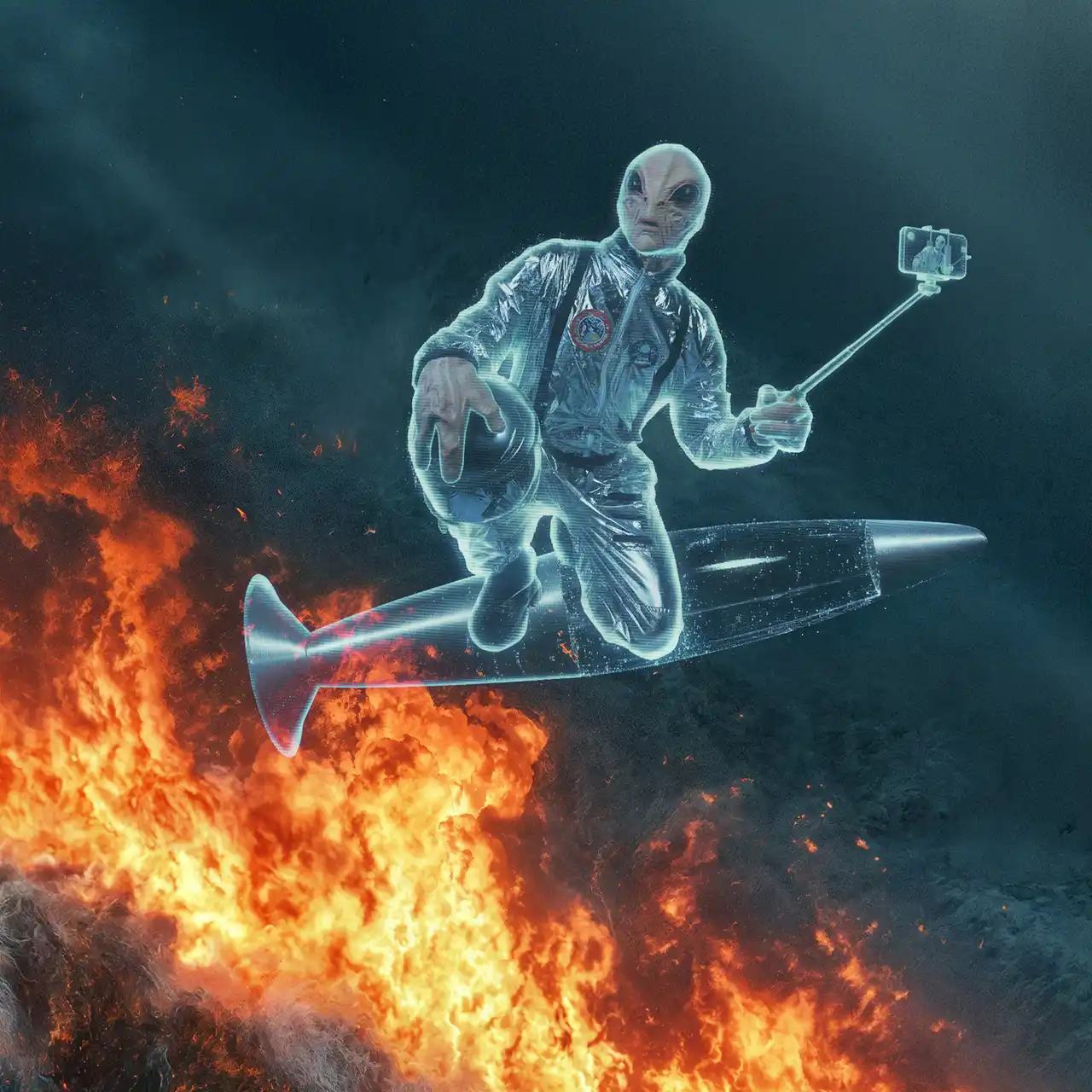
The second surfer, through his visual identity, hints at the answer to the question of who in the 21st century still craves power and war so desperately. Greedy little men in neckties, of course. The third rides the waves of a lake of fire: a clown whose shameless gluttony heralds famine for all but himself, while also reminding us that instant solutions are not necessarily good ones in the long run. And as the cherry on top, the cosmic flood is joined by an alien in the guise of a self-satisfied influencer tourist from another planet, dressed in camouflage astronaut gear, lying in wait for the final collapse of an inferior civilization.
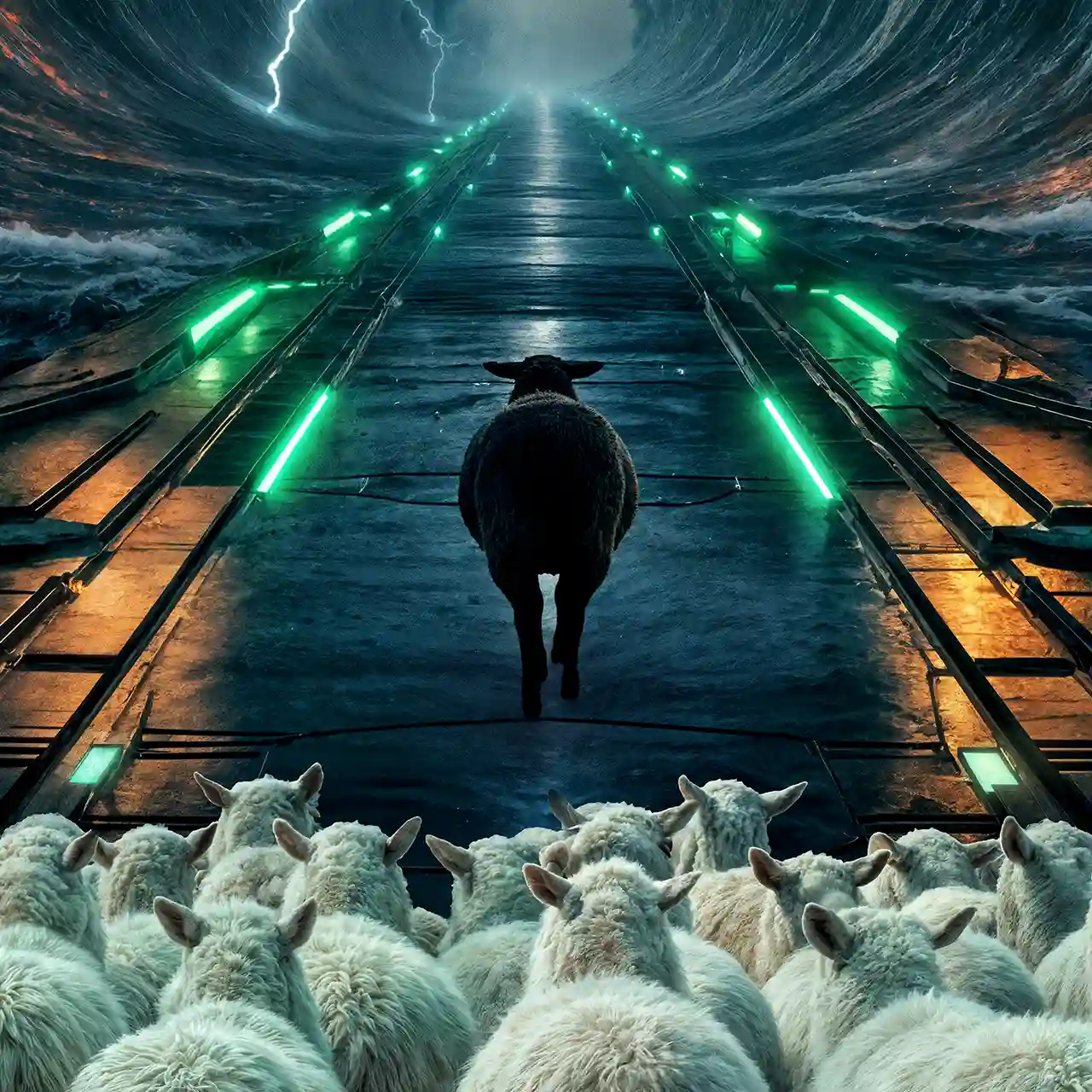
Despite the fact that the exhibition draws on the horror genre, the intention behind depicting these dark prophecies is ultimately to find a way toward potential light. Hence the embodiment of the redemptive Noah's ark in the figure of the black sheep, the only one daring enough to step out of the crowd and leave the apparent comfort of the futuristic paradise spectacle in search of resistance and a better tomorrow.
Artists: Nejc Trampuž & Claudi Sovrè
Mythological foundations, costuming and photographic portraiture: Claudi Sovrè
AI-generated static and dynamic imagery, collage: Nejc Trampuž
Sound design: Tim Kropivšek
AI tools: Kling, Nano Banana, Flux, Midjourney, Krea Upscaler, Firefly, ElevenLabs